





Postproduction in times of AI: tools… and extinction?
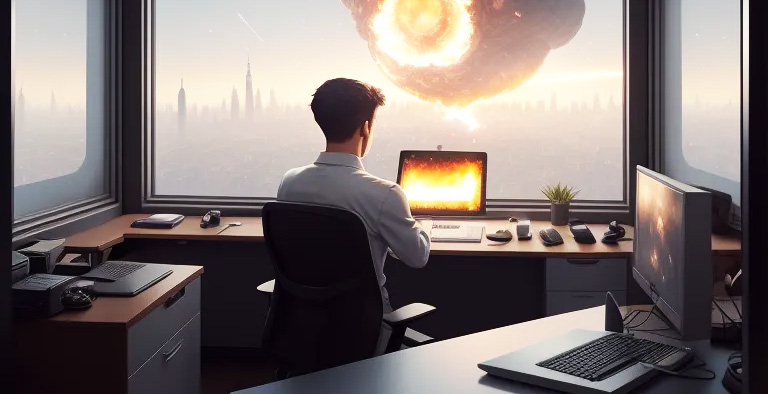

In this Tribune, Fran Porras, VFX supervisor of the visual effects studio Dare Planet, reflects on the growing use of AI (Artificial Intelligence) in post-production processes and how this phenomenon is changing the industry.
It is said that when Phil Tippett, responsible for the practical effects of Jurassic Park, observed the computer-generated dinosaurs that ILM had developed for the film, he managed to tell its director, Steven Spielberg: “I just went extinct”.
The audiovisual industry has experienced all kinds of transformations and in its genetic memory is the ability to adapt and overcome the challenges it has faced. We reached 2024 with a long-awaited agreement between the Actors Union (SAG-AFTRA) and the Producers Alliance (AMPTP) that has paralyzed productions for 118 days and that, among other requests, demanded protection against the rise of Artificial Intelligence. These measures, far from being anecdotal, show a short-term (if not imminent) scenario, in which even the image of the actors and their voice will be easily replicable thanks to technologies based on generative Artificial Intelligence.
Film post-production and visual effects industry are part of that threat; being, in turn, one of the sectors most vulnerable to change. We are facing a technological migration about whose scope we can only speculate, but whose results are already underway. On the table is the debate about whether these tools will make our work easier, or if They are part of an announced “extinction”.
AI tools already applied in the VFX world
According to analysts Goldman Sachs, Technology based on Artificial Intelligence could expose the equivalent of 300 million jobs, although most jobs and industries would be only partially exposed to this change. More than a replacement, we would be talking about a complementation. Those of us who work in front of the computer processing frames, We have been living with some of these tools for months, and we are already clear that they have come to stay. That big software developers like Foundry o Adobe are developing and implementing AI-based tools in image composition and editing programs, supports the discourse that the people involved in these processes will not be replaced by machines, since That would go against their business model.. Today, tools like “Copycat" of Nuke are being successfully applied in those repetitive tasks in which the Tool training compensates for the volume of planes to which a certain effect must be applied. The tools of matte extraction, continue to evolve and although they promise to lighten entire days of rotoscoping, to this day, they still do not compensate for the virtues of planting a good chroma. In this regard, and in order to satisfy the curiosity of an important part of the readers, I am afraid that these advances They are not being reflected in the budgets (at the moment).
Those of us who work in front of the computer processing frames, We have been living with some of these tools for months, and we are already clear that they have come to stay.
The most disruptive aspect that this technology poses in our industry has to do with the artistic nature of many of the tasks associated with visual effects. Artificial Intelligence tools for image generation through text, or through images such as Midjourney, Pika, Krea O Stable Diffusion, offer the possibility of generating highly realistic images through a properly formulated description. While it is true that these processes require a specialized profile that understands the tool, and is capable of bringing the result to a specific narrative, the artistic execution is relegated to the background. Mastery with a pencil is no longer as essential in the elaboration of a conceptual design or a “mattepaint”, as it is to know and operate with each and every one of the tools that appear on the market daily. For some it will mean a democratization of processes, others may feel it as the death of art; but, above that, there will always be a person specialized in the process.
As if that were not enough, if this technology has one advantage, it is its scalability. Today you can access it and obtain great results both at the user level using a personal computer, and on the largest audiovisual scales. Differentiating yourself is going to become one of the biggest challenges of the sector.
AI, reflection of the sign of the times
In his famous essay “The work of art in the age of its technical reproducibility” (1936), Walter Benjamin He said: “Cinema is not only characterized by the way in which man presents himself before the device, but also by how with the help of it the world around him is represented.”
He cine, as a tool of artistic expression, It is still a reflection of the world in which we live. And yes: this is going to be the century of artificial intelligence, automation and the democratization of talent.
Surely Benjamin did not have in mind the scope that the technology would have in the way we perceive and represent the world. The way in which a Artificial intelligence It generates a work of art for you, directly, it would dismantle its concept of the aura. More accurate is this last mention of how cinema, as a tool of artistic expression, It is still a reflection of the world in which we live. And yes: this is going to be the century of artificial intelligence, automation and the democratization of talent.
Fran Porras
VFX supervisor of the visual effects studio Dare Planet
Did you like this article?
Subscribe to our NEWSLETTER and you won't miss anything.